

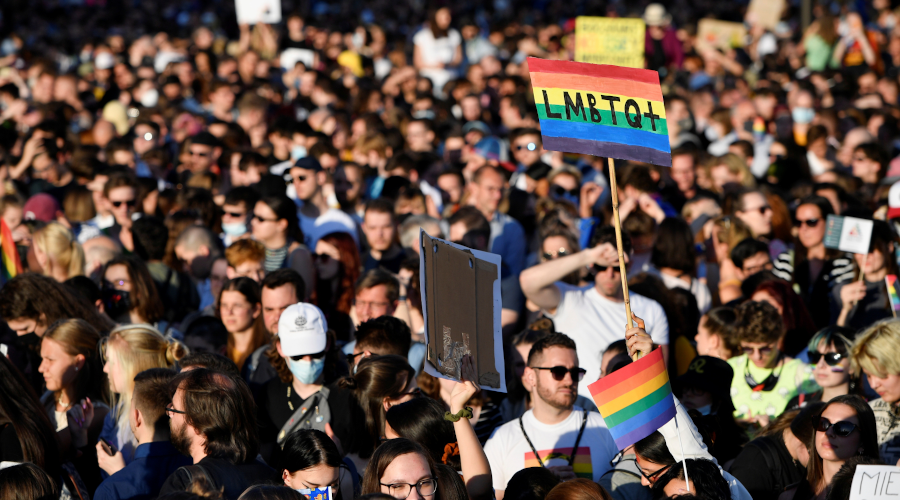
Thousands of people gathered in the streets, waving rainbow flags. They were demonstrating against a proposed law by the ruling Fidesz party, which, under the guise of child protection, would prohibit minors from accessing content that "includes, popularizes, or depicts gender-affirming and homosexuality," ...
... as the proposed law states verbatim. The teaching of content that "popularizes" homosexuality or trans identities in schools is also to be prohibited. Certain NGOs would be barred from offering courses on sex education or drug prevention in schools.
Legal changes are intended to punish pedophilia more severely
The adopted legislative changes are summarized as: "Amendments to several laws to take stricter action against pedophile criminals and in the interest of child protection." They also include stricter penalties for sexual violence against children and adolescents.
The conflation of homosexuality and the representation of transgender people with the accusation of pedophilia aligns with the ideology with which the Fidesz party and its junior coalition partner, the KDNP (Christian Democratic People's Party), have been restricting the rights of sexual and gender minorities for years.
Just over a year ago, the Fidesz-KDNP majority in parliament passed a law making it impossible to change the sex officially registered at birth in official documents and certificates to reflect one's gender identity.
Furthermore, since December 2020, it has been legally impossible for non-heterosexual, transgender, or intersex people in Hungary to adopt children. The constitution now stipulates that "the mother is a woman and the father is a man." Since 2018, universities have been prohibited from awarding degrees in gender studies.
This homophobic and transphobic ideology is spread throughout society even beyond the scope of laws. For example, a children's fairy tale book representing sexual and ethnic minorities was labeled "homosexual propaganda" by the Fidesz party.
Football players and television broadcasters criticize the government
Prominent figures are increasingly speaking out against the government's exclusionary ideology. For example, Péter Gulácsi, the first goalkeeper of the Hungarian national football team and RB Leipzig player, has publicly supported the "A család az család" (Family is Family) campaign, which advocates for the recognition of rainbow families.
Critical voices are also coming from the private sector. The television channel "RTL Klub," part of the German RTL Group, criticized the new law in advance, stating that it "causes considerable economic damage to the media market and makes it more difficult for all citizens to access certain content." Even content like "Bridget Jones," the series "Friends," or parts of the "Harry Potter" films could, under the new law, only be shown late at night as content restricted to viewers over 18.