
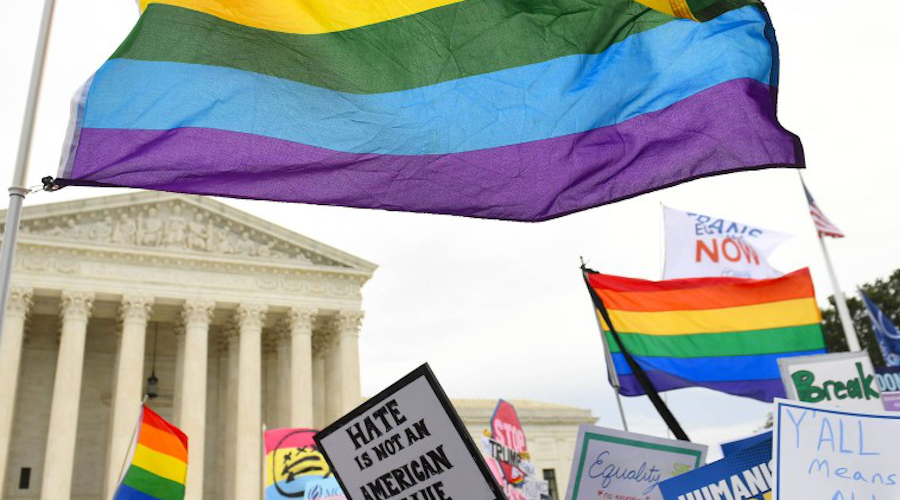
The Supreme Court, as the final court in a series of lawsuits, had to rule on three such cases: those of two gay men and one of a transgender woman. One man worked in a program to help neglected, abused children in Georgia and was fired when he joined a gay regional baseball league. The other was a skydiving instructor…
…who, before a tandem skydive, tried to allay a customer's concerns about close physical contact by remarking that he was "one hundred percent gay"—a comment that led to his dismissal. He died in a skydiving accident in 2014, but his family appealed his case.
The plaintiff in the third case also did not live to see the verdict. She died just over a month ago. While still a man, she had worked for six years at a funeral home in Michigan before declaring in 2013 that she was transgender and would henceforth present as a woman. The company's owner explicitly cited her transgender identity as the reason for her subsequent dismissal.
Clear and simple
Although proponents and opponents of extending the prohibition of discrimination argued for years, and most federal appeals courts advocated a restrictive interpretation of the term "gender," Judge Gorsuch's reasoning was clear and straightforward. Known for his rigorous adherence to the text, the judge stated that if an employer dismisses an employee because of homosexuality or transsexuality, then gender plays a necessary and undeniable role in that decision. He would not have made the same decision if it had been based on characteristics or actions of a different gender. Therefore, the prohibition of discrimination based on gender was clearly applicable.
The decision refutes those who preemptively claimed that a conservative majority on the Supreme Court would inevitably lead to restrictions on civil liberties. Brett Kavanaugh, the second justice appointed by Trump, made it clear in a dissenting opinion that he wanted the issue resolved by Congress, not the court. "Our role is not to make or amend laws," Kavanaugh wrote. "As written, Section VII of the Civil Rights Act does not prohibit discrimination based on sexual orientation."
The ruling is not a blank check for gay and transgender people. It refers solely to discrimination in the workplace, but even there it excludes what would be permissible if, for example, an employer were to cite religious reasons that would prohibit them from hiring a gay or transgender person. Gorsuch left no doubt that such considerations would have been taken seriously if raised by the defendants. However, they were not part of the legal arguments the Supreme Court had to consider in this case.
Does Trump need to backtrack?
It is also unclear what role the ruling will play in other areas of social life in the US and how quickly any changes would take effect. After the Obama administration adopted an interpretation of the term "sex" that the Supreme Court has now upheld, the Trump administration deliberately redefined the term "sex" restrictively in various anti-discrimination protections, defining it as "male or female as determined by biology." Just last Friday, the Department of Health and Human Services announced that, based on this reasoning, a discrimination protection in healthcare would be eliminated by mid-August.
Der Schritt ist Teil eines ganzen Programms. Schon kurz nach seiner Amtseinführung hatte Trump im Februar 2017 angeordnet, dass eine Empfehlung der Regierung Obama annulliert wird, die den Schulbehörden geraten hatte, transsexuelle Schüler sollten sich bei der Benutzung von Toiletten und Umkleideräumen auf ihre Geschlechtsidentität abstützen können und nicht ans Geschlecht laut ihren Geburtsscheinen gebunden sein.
The move is part of a larger program. Shortly after his inauguration in February 2017, Trump ordered the rescission of an Obama administration recommendation that school authorities should be able to use restrooms and locker rooms based on their gender identity, rather than being restricted to the sex assigned to them at birth.
In a press conference, Trump stated that he would respect the Supreme Court's decision. He called the ruling "very powerful" and said, "That's what they decided." However, he did not clarify what this would mean for his administration's executive orders. While Democrats and LGBT activists celebrated the ruling, several Republicans stated that they, too, could live with it.